
About Me
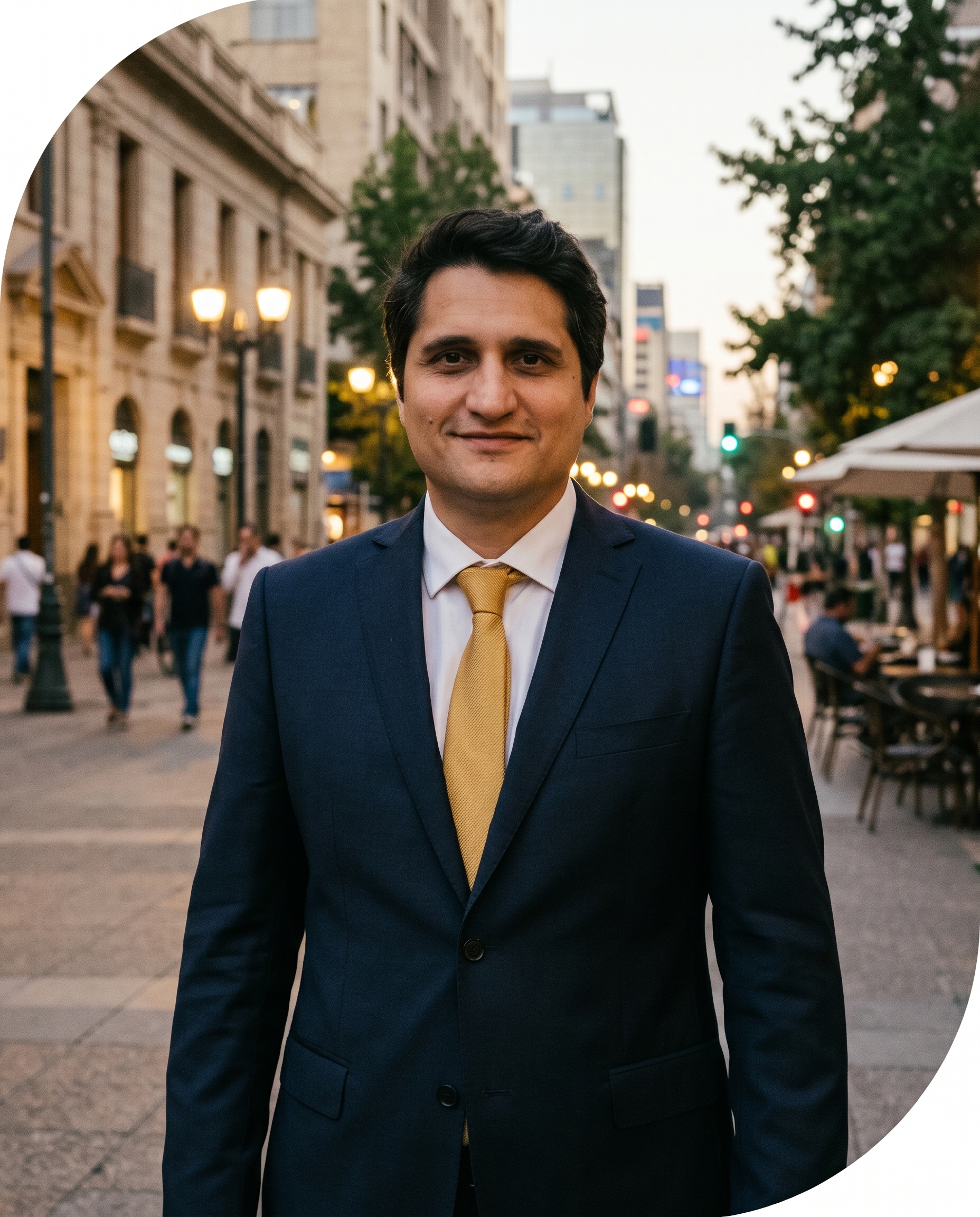
Hi, I'm Francisco F. Pinochet
Hey, I’m Francisco. I got hooked on technology back when the internet sounded like a modem handshake and you learned by breaking things and figuring out why. Plenty of things got broken. Most of them eventually worked again.
Where I come from
I’m the son of Chilean parents and grew up as a missionary kid, but I spent most of my life in Alabama, where the Scots-Irish settled in such numbers that even in the Deep South I was surrounded by Celts. It felt a bit like a family reunion, only with better barbecue. Between a Chilean home, a Southern upbringing and a fair bit of moving around, I learned early how to adapt, how to listen, and how to pack quickly. I’ve come to think the space between cultures is where the most interesting problems, and the best solutions, tend to be.
Further back, my father’s line runs to Brittany, the Celtic corner of France, settled long ago by Britons who crossed the Channel. That makes me, by a few centuries and a stretch of water, a distant cousin of the British, which may explain the dry sense of humour. In colonial times, a Breton merchant in the family made the long voyage to Chile and stayed, and the family became part of the country’s story. It seems trading between distant markets runs in the blood. Somewhere along the way the family kept a little of Brittany alongside everything Chilean, so I grew up with a culture that’s distinctly its own and Chilean through and through. My mother’s side added Sicily to the mix, where family gatherings come first and the food is always good.
The name was once spelled Pignochet, and there’s still a beach by that name on the bay of Mont-Saint-Michel. It’s on the Norman side, like the Mont itself, which, as any Breton will tell you, is entirely the river’s fault. We did manage to get along in 1066, at least.
Along the way
I started taking computers apart at 11 and never really stopped. Dial-up was my window to the world. I caught the last of the BBSs before the web swallowed them, and I stayed up far later than anyone approved of.
I was fascinated by machines I’d never get near, like Cray supercomputers and Multics, the system Unix grew out of. I admired them from a distance, which is how most of us ever saw a Cray. In high school I got hooked on computer security, mostly learning how things break so I’d know how to protect them. In my late teens I fell hard for the Mac. Being Unix underneath, it felt less like switching sides and more like coming home.
Radio had a hold on me too: the idea that the air around us is full of signals, if you know how to listen. Years later, software-defined radio turned those signals into something I could take apart on a computer, which was more or less the dream. Some of the work I’ve enjoyed most was helping deliver and set up new transmitters for radio stations serving Indigenous communities in Guatemala and beyond, learning from old radio engineers who’d forgotten more than most of us will ever know. There’s nothing quite like hearing a station come on air and knowing a whole community can hear it too.
I went on to study Computer Engineering at the University of South Alabama. I spent a lot of time in the library, learning from anyone willing to teach me and meeting people I still learn from today. College taught me a great deal, including that I’d rather build things than study them. So I left to start a business.
Since then I’ve worked in IT, helping businesses get their technology working and building my own along the way. I’ve worked across networking, Linux and Windows, with a bit of Solaris back when that was the serious stuff. I never went deep on OpenBSD, but I have a great deal of respect for anyone who takes security that seriously by default. Mostly it’s the parts people only notice when they break: phone systems, servers, networks and security.
Most of my clients have been small and medium-sized businesses, including some in industries where security and compliance aren’t optional. Some of the work was on systems that had to work the first time and every time after. Some of it I can talk about. Some of it I can’t, and I’m told that’s how it should be.
What I do now
These days I run Fastcomcorp, a technology consulting and services company I founded in 2011, based in Mobile, Alabama. We help small and medium-sized businesses with digital transformation, which in plain terms means looking at how a business actually works and finding where technology can make it simpler, faster or more secure. That usually starts with the business processes themselves, then moves to engineering the digital infrastructure underneath: phone systems, servers, networks and cybersecurity.
It’s work that matters more every year. Smaller businesses face the same security threats and compliance demands as large companies, usually without the budget or staff to handle them. That gap is where we’ve done our best work for fifteen years, and it’s only getting wider.
I’ve also consulted on critical infrastructure, the kind of systems a community or economy can’t afford to lose, and that’s where I see my work heading. Today’s attackers move faster than ever, using AI to find weaknesses, write convincing lures and adapt in hours rather than months. At the same time, the line between signals and cyber is disappearing: more of what needs protecting now talks over the air, and the airwaves have become part of the attack surface.
The organizations most at risk, the electrical grid and banking among them, can’t afford to defend at yesterday’s pace, or to defend alone. That’s why I’ve been pushing for closer collaboration between grid operators and the parts of law enforcement whose job is to protect them, so threats get shared and acted on sooner. I bring everything I’ve picked up along the way, from radio towers and server rooms to compliance audits and boardrooms, to helping build systems that are secure from the ground up and resilient when something does go wrong. It’s also why I keep a close eye on financial technology and digital assets, where the stakes are just as high and the attackers just as determined.
In recent years much of my life has been in Latin America, especially Chile, working with businesses and a few sensitive sectors that are going through many of the same changes with fewer people to guide them. Just as rewarding has been helping people and businesses from across the region find their way, whether that’s securing what they’ve built, modernizing how they work, or figuring out how to grow beyond their own borders. Plenty of people once took the time to guide me, and I think that’s a debt best paid forward.
Every now and then I also get to collaborate with colleagues in the UK, and we tend to find ourselves on the same wavelength. Working across the US, Latin America and Britain has given me a view most firms don’t have, and occasionally three very different ideas of what “urgent” means. Now my focus is back on the US, and on releasing new products I’ve been building quietly behind the scenes for years. More on those soon.
I’m always glad to talk with people who want to build something worthwhile, whether that’s a client, a partner or an investor. If you see an opportunity where technology, two markets or a hard problem meet, I’d like to hear about it.
What I write about
Mostly tech and business: how systems work, why they fail, and what that means for the people relying on them. Expect cybersecurity, infrastructure, the occasional piece of old hardware, and what I’m seeing across the US, Latin America and beyond.
Now and then I turn the same curiosity on economic and political systems. The approach is the same: take it apart, see how it works, and report back honestly. I’m more interested in how things work than in picking sides, but I won’t pretend I don’t have opinions.
Everything here is my own personal view. It doesn’t speak for Fastcomcorp, my clients, or anyone I’ve worked with, and it’s offered in the spirit of a conversation, not the final word. Reassembly not guaranteed.
Working together
If you’ve got something that needs figuring out, I’d be glad to hear about it. Credentials and references are available on request.
Business inquiries
Fastcomcorp
11 North Water Street, Suite 10290.
Mobile, Alabama 36602
Verify PGP Fingerprint
PGP Fingerprint: C55D AF9C B704 790C DDFD 3FB0 95EF 6264 F53B 1174